Unauthorized immigration served as a clear housing-demand shock that raised local prices and rents while housing supply remained flat—exactly the kind of multi-factor pressure that makes one-size-fits-all densification mandates harmful to neighborhoods.
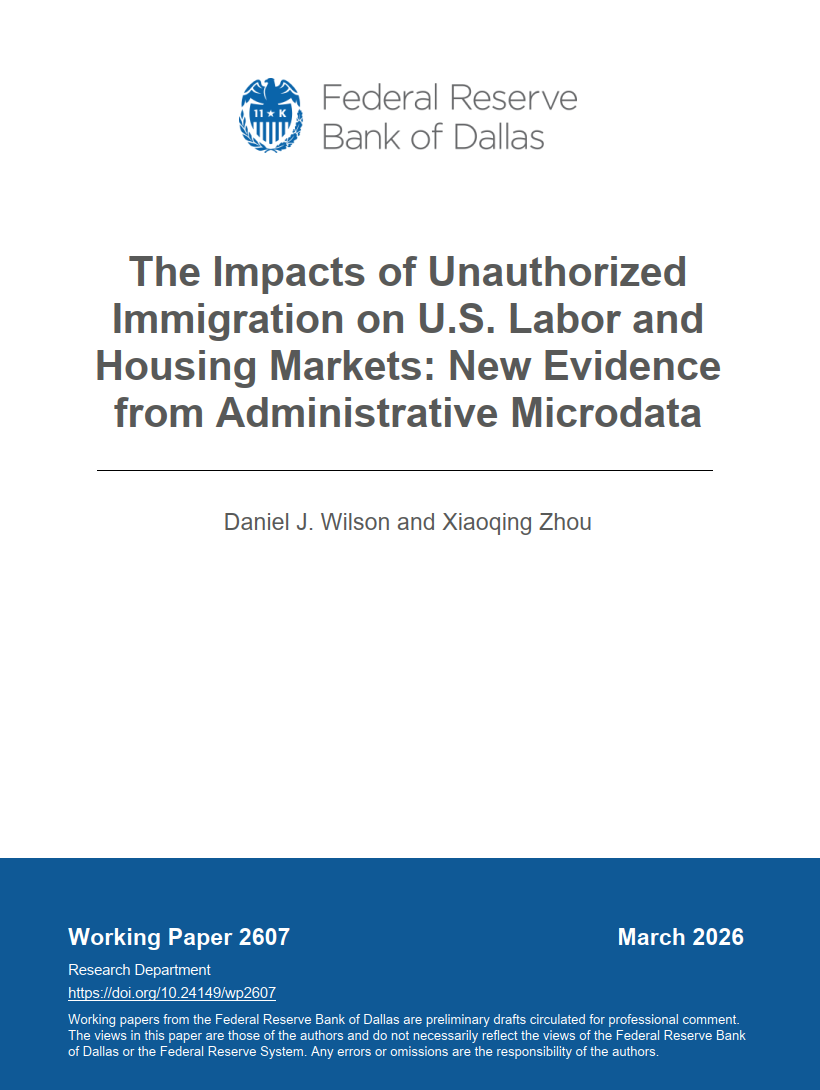
From early 2021 to early 2024 the U.S. saw an unprecedented surge in unauthorized immigration (roughly 7 million net additions according to CBO figures cited in the paper), followed by a sharp slowdown. Dallas Fed economists Daniel J. Wilson and Xiaoqing Zhou use newly available administrative micro data on individual immigrants (immigration court records, paroles, got-aways, etc.) to construct local measures of unauthorized immigrant worker flows (UIWF) at the commuting-zone and metro level. They then exploit cross-local variation with a carefully constructed two-way leave-out shift-share instrument to isolate causal effects.
Labor-market results
A 1% inflow of unauthorized workers relative to local employment boosted private nonfarm jobs by about 0.96%. This increase matched the rise closely, with no clear drop in average weekly wages. Effects were especially strong in Leisure & Hospitality. UIWF lowered labor income per capita. The change reflects shifts from lower-wage workers. Additionally, government transfers declined significantly (–4.5% total and –5% per capita). These workers expanded the local labor force and the employment base. They did not cause the wage collapse some feared. They also reduced certain fiscal transfers.
Housing-market results (the core local concern)
The same 1% UIWF shock raised local house prices by about 2.2%. Rents rose by about 1.4%, with effects slightly smaller for single-family homes and slightly larger for multi-family. The calculations imply UIWF contributed about 30% to house-price growth. Furthermore, UIWF contributed roughly 20% to rent growth in the typical local market during the boom. Critically, there was no significant increase in new housing supply (building permits relative to existing stock were small and statistically insignificant across single-family, multi-family, and total). Construction-sector employment effects were also muted. The paper’s conclusion is direct: unauthorized immigrant worker inflows functioned primarily as a housing demand shock against short-run inelastic supply.
These findings line up with what Our Neighborhood Voices has long argued. Housing cost pressures are multi-faceted. Jobs growth, macroeconomic conditions, interest rates, and demographic inflows (including this post-pandemic unauthorized surge) are major demand-side drivers. Simply mandating more density or stripping local zoning, planning, and approval authority does not automatically produce the supply response needed, nor does it mitigate the localized impacts—higher rents and prices, neighborhood change, infrastructure strain—that residents experience. The paper’s evidence that supply stayed flat while demand rose underscores why local communities must retain meaningful control over zoning, site planning, mitigation measures, and the pace of densification. Top-down “build more everywhere” policies ignore these real, measurable demand shocks and the uneven geographic distribution of the impacts.
The authors are careful to note their results speak to local (not necessarily national) effects and focus primarily on the 2021–early 2024 boom. Still, the housing findings are clear, consistent with earlier work on immigration and rents/prices (e.g., Saiz 2007), and reinforce that unauthorized immigration’s housing consequences operated through demand, not through an automatic expansion of housing stock.